From Penny-Farthing to Safety Bicycle: Why Two Similar Wheels Won
From penny-farthing to safety bicycle, see how the lower frame and rear-chain drive changed mounting and steering, and what to look for in a museum display.
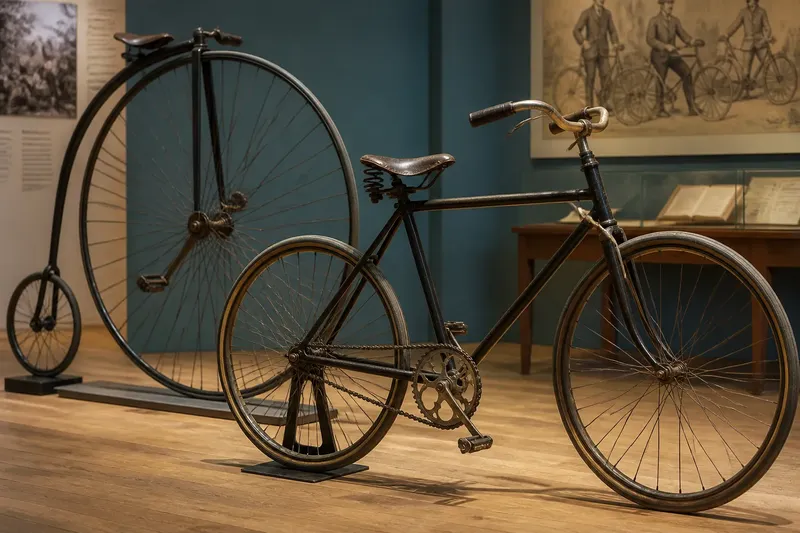
From penny-farthing to safety bicycle, the change is easiest to see at the saddle: one rider sits high above a huge front wheel; the other sits between wheels of similar size. That lower arrangement and the rear-chain drive helped make the bicycle’s familiar form practical to mount and steer, though the change did not happen all at once.
The penny-farthing, also called the ordinary, and the safety bicycle answered different riding preferences. The high-wheeler offered direct drive and a distinctive riding position. The safety bicycle separated steering from pedalling and put the rider nearer the ground. Neither machine tells the whole story of bicycle development, but comparing them makes the design shift plain.
What did the penny-farthing ask of its rider?
The penny-farthing had a very large front wheel and a small rear wheel. Its pedals turned the front wheel directly, so each pedal revolution moved the bicycle according to that wheel’s circumference. There was no chain or separate gearing between the pedals and the driven wheel.
The arrangement suited a rider prepared to learn a specialised mount and balance a high seat. The rider sat above the front axle, close to the wheel that both drove and steered the machine. A sudden stop or obstruction could send the rider forward, and getting on or off required a deliberate technique.
That does not make the high-wheeler a failed version of the modern bicycle. It was a distinct design with a particular appeal. It made less sense for frequent stops or for riders who wanted a straightforward mount.
How did the safety bicycle change the layout?
A smaller front wheel with pedals attached directly would cover less ground per pedal turn. The chain offered another arrangement: pedals turned a chainring, and the chain drove a sprocket at the rear wheel. That let the front wheel steer while the rear wheel received the rider’s effort.
With the drive no longer tied to the front wheel’s size, builders could use wheels of similar proportions and choose a suitable relationship between pedal and wheel movement. A lower saddle and a frame placing the rider between the wheels became practical parts of the same design.
The diamond frame, made from joined tubes, connected the head tube, bottom bracket and rear wheel in a compact structure. Other frame forms were tried, but the diamond layout became a familiar way to support the rider and connect the bicycle’s main parts.
What changed for everyday riding?
A lower seat changed the business of mounting and stopping. The rider was closer to the ground when slowing down, without the same height above the front wheel. That reduced reliance on the high-wheeler’s particular mounting routine; it did not make falls or collisions impossible.
The chain also let builders treat wheel size, rider position and pedal-to-wheel movement as related but separate choices. The bicycle no longer needed an enormous front wheel to travel a useful distance with each pedal turn. This gave designers room to refine the layout without tying every decision to the driven wheel’s size.
It is safer to describe the cultural effect with care. A lower bicycle that was easier for some riders to mount and control could be imagined for more than specialist riding. Cost, roads, social expectations and access still shaped who rode, so the design alone did not make cycling available to everyone.
Which details should a museum visitor compare?
Say you are visiting a museum display with a penny-farthing and a safety bicycle, and the staff permit supervised handling. You want to understand why the second design felt more accessible, not to ride either machine away. Start by checking the display rules and asking a staff member what parts may be touched. If handling is not permitted, compare the silhouettes and mechanisms from outside the barrier instead.
If the staff allow a supervised look, compare the saddle height, wheel proportions, steering arrangement and drive. On the penny-farthing, note the pedals fixed to the large front wheel and the rider’s high position. On the safety bicycle, trace the chain from the pedals to the rear sprocket, then identify the separate front steering wheel. The visible result is a clear contrast in how each machine asks the rider to sit and control it.
For a close inspection, use these observations to decide what the display can teach:
- Check whether the penny-farthing’s pedals are attached to the front wheel; if they are, note that the wheel provides direct drive, and if the mechanism is hidden, ask staff or rely on the display label.
- Check whether the saddle sits high above the front axle; if it does, identify mounting height as a distinctive demand, and if the view is blocked, compare the side-on silhouette.
- Check whether the safety bicycle has a chain running to the rear wheel; if it does, trace how drive is separate from front steering, and if it is concealed, look for a diagram or label.
- Check whether the two safety-bicycle wheels appear similar in size; if they do, connect that proportion to the lower layout, and if perspective makes comparison unclear, use the display’s side view.
- Check whether the front wheel turns independently of the pedals; if it does, identify steering as a separate task, and if the mechanism cannot be seen, ask a guide to point it out.
- Check the display’s handling rules before touching any component; if supervised handling is allowed, follow the staff member’s instructions, and if it is not, keep the comparison visual.
How did the safety bicycle become familiar?
“Safety” described a relative contrast with the high-wheeler, not an absence of risk. The lower arrangement reduced the particular danger of being thrown forward from a great height, while the chain drive and two similar-sized wheels gave builders a different combination of position and control. Brakes, tyres and frame details also varied and continued to develop.
The design is best understood as a set of parts working together: a steerable front wheel, a driven rear wheel, a saddle between them and a frame joining the components. That layout became recognisable and could be refined without changing its basic relationships. It was not simply a penny-farthing with a smaller front wheel.
What do people ask about the change?
Was the penny-farthing the first bicycle?
No. It followed earlier pedal-powered machines and was one stage in a longer sequence of designs. Its large front wheel made it distinctive, but it did not establish the safety bicycle’s arrangement.
Why was it called a safety bicycle?
The name distinguished its lower arrangement from the high-wheeled ordinary. It signals a relative change in riding position, not a promise that a rider could not fall.
Did the chain make the safety bicycle possible?
The chain was central because it let the pedals drive the rear wheel while the front wheel steered. Similar-sized wheels alone would not have solved the shorter travel per pedal turn of a small directly driven front wheel.
Why do modern bicycles retain this basic arrangement?
It gives the rider separate roles for steering and drive, with the saddle between the wheels. Modern bicycles vary in frame, wheel and component design, but the arrangement remains adaptable.
What is the clearest distinction between the two?
Compare what each layout asks of its rider. The penny-farthing combines a high position, direct front-wheel drive and a specialised mount. The safety bicycle places the rider between similar-sized wheels and separates steering from drive. The difference is rather like moving from a tall stool to an ordinary chair: the change is not glamorous, but getting on and settling down becomes a different proposition.
When tracing the shift from penny-farthing to safety bicycle, keep the relationship between rider and wheels in view. Similar-sized wheels mattered, but so did the chain and the frame that put the saddle between them. Together, those choices made a recognisable layout that later designers could refine.